
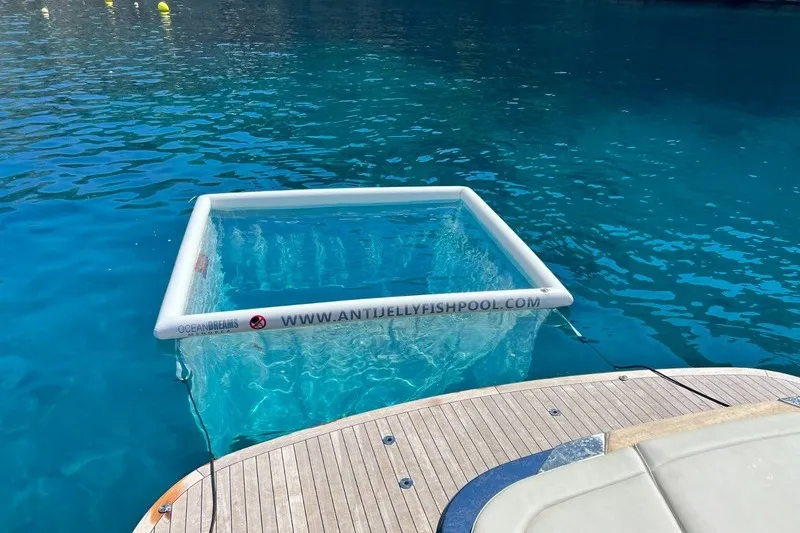
An anti-jellyfish pool is one of the most sought-after accessories for modern superyachts and luxury boats. As jellyfish populations surge across the Mediterranean, Adriatic, and tropical seas worldwide, the ability to swim safely in the open ocean has become a genuine concern for yacht guests. The solution is elegant, practical, and increasingly popular: a purpose-designed inflatable sea pool with integrated anti-jellyfish mesh protection. This guide covers everything you need to know about anti-jellyfish pools in 2026.
What Is an Anti-Jellyfish Pool?
An anti-jellyfish pool — also known as a sea pool or ocean pool — is an inflatable floating enclosure that deploys from the stern or swim platform of a yacht. It consists of an inflatable ring or tube structure that sits on the water's surface, combined with a fine mesh net that hangs below and creates a fully enclosed swimming area. The mesh allows water to circulate freely while preventing jellyfish, sea urchins, fish, and other marine organisms from entering the swimming zone.
These pools are designed to float around the yacht, providing a clean, safe, and naturally temperature-regulated swimming environment using the actual ocean water. There is no need for pumps, filters, chemicals, or heating — the sea itself provides the water, and the mesh does the protective work.
Anti-jellyfish pools differ from traditional inflatable pools in one critical way: they are open to the ocean water at the base, meaning swimmers enjoy the natural sensation of being in the sea, with all the associated benefits (buoyancy, minerals, temperature), minus the marine hazards.
How Does It Protect from Jellyfish?
The core innovation of the anti-jellyfish sea pool is its mesh net system. Here's how the protection works:
Fine Mesh Construction
The mesh used in premium anti-jellyfish pools has openings small enough to block even the tentacles of the most common jellyfish species, including the Portuguese Man O' War, moon jellyfish, and the highly venomous Physalia. The mesh is typically made from UV-stabilized nylon or polyester, offering excellent durability and resistance to salt water degradation.
Full Perimeter Seal
The mesh connects directly to the inflatable ring at the waterline and extends downward to a depth that prevents jellyfish from swimming underneath. The weighted bottom edge of the mesh ensures it stays tensioned and vertical, creating an effective barrier even in mild current conditions.
Entry Points
Access ladders and entry points on quality sea pools are designed with overlapping mesh flaps or zippered closures that maintain protection while allowing swimmers easy entry and exit. These designs are carefully engineered to prevent jellyfish from entering through the access gap.
Additional Benefits Beyond Jellyfish Protection
While jellyfish protection is the primary purpose of these sea pools, the benefits extend much further:
- Protection from Other Marine Life: Sea urchins, fire coral, large fish, and other potentially hazardous marine organisms are kept out of the swimming zone.
- Safe Swimming for Children: Parents can relax knowing their children are in a fully enclosed, monitored swimming area away from currents and ocean hazards.
- Clear Water Quality: In busy anchorages where surface water may contain debris, the pool creates a cleaner micro-environment for swimming.
- Defined Swimming Zone: The visible boundary of the pool helps guests stay close to the vessel and within sight of crew, improving overall safety management.
- Psychologically Reassuring: Many guests who are hesitant to swim in the open ocean feel completely comfortable and confident within the enclosed sea pool.
- Aqua Lounge: When not used for swimming, the pool can serve as a floating lounge with inflatable furniture, a perfect spot for sundowners or relaxation.
Who Is an Anti-Jellyfish Pool For?
Anti-jellyfish sea pools are an excellent investment for a wide range of yacht owners and charter operators:
Superyacht Charter Operators
For charter businesses, guest safety and comfort are paramount. Offering a protected sea pool significantly enhances the charter experience and gives you a compelling differentiator in a competitive market. Guests from non-maritime backgrounds particularly appreciate the security of an enclosed swimming area.
Family Yacht Owners
Families cruising with young children will find the anti-jellyfish pool invaluable. It provides a safe, visible, and fun aquatic play zone that gives parents peace of mind while allowing children maximum freedom and enjoyment.
Med Season Cruisers
The Mediterranean jellyfish season, which peaks from June to September, coincides with the prime cruising season. Yachts spending time in Greek waters, the Adriatic, the Balearics, or the Amalfi Coast will almost certainly encounter jellyfish blooms. An anti-jellyfish pool transforms a potentially swim-free day into a full aquatic experience.
Tropical Destinations
In the Caribbean, South East Asia, and other tropical sailing grounds, the variety and abundance of potentially harmful marine life makes an enclosed sea pool a year-round asset rather than a seasonal one.
How to Set Up an Anti-Jellyfish Sea Pool
Setting up an anti-jellyfish pool is designed to be manageable by two crew members within 20-30 minutes:
- Unpack and Inspect: Remove the pool from its storage bag and lay it flat on the deck. Inspect the mesh for any tears or damage before each deployment.
- Inflate the Ring: Using the supplied electric pump, inflate the ring tube to the recommended pressure (approximately 0.2-0.3 bar). Never over-inflate — the tube should feel firm but have slight give.
- Deploy into Water: With the vessel stationary at anchor, carefully lower the inflated ring over the stern. Two crew members should handle this step to control the pool and prevent contact with the hull.
- Tension the Mesh: Allow the mesh to unfurl naturally in the water. Check that all corners and edges are properly extended. Adjust the weighted bottom if needed.
- Secure to Vessel: Attach the securing lines to the vessel's cleats, swim platform D-rings, or dedicated attachment points. Use appropriate rope tension to prevent the pool from drifting or colliding with the hull.
- Pre-Swim Check: Before guests enter, verify that no marine life has been trapped inside the pool during deployment, and confirm all access points are properly secured.
Our Anti-Jellyfish Sea Pool Collection
We offer the widest range of anti-jellyfish sea pools and yacht pools available, all manufactured to the highest marine-grade standards. Our products are trusted by superyacht crews and owners across the Mediterranean, Caribbean, and Pacific.
Our range starts with compact options ideal for smaller vessels and scales up to full-size superyacht pools:
- Yacht Pool 5x4m — Our premium flagship anti-jellyfish sea pool, designed for superyachts seeking the ultimate swimming experience. 20 sqm of protected ocean swimming, with reinforced mesh, luxury-grade materials, and complete attachment hardware.
- Boat Pool 4x3m — The most popular choice for mid-size yachts. Perfect balance of swimming space, ease of deployment, and storage requirements.
- Boat Pool 3x3m — Ideal for smaller yachts and motor cruisers. Compact and lightweight, but still offering excellent jellyfish protection for up to 4 swimmers.
- Boat Pool 5x4m — A larger format boat pool for sailing yachts and motor yachts with ample swim platform space.
- Boat Pool 6x5m — Our largest standard pool, delivering 30 sqm of protected swimming for the most discerning superyacht guests.
Browse our complete Yacht Pool & Anti-Jellyfish Pool collection, or read our in-depth yacht pool guide for expert advice on choosing the right model for your vessel.
Care and Maintenance of Your Sea Pool
A well-maintained anti-jellyfish sea pool will serve you reliably for many seasons. Follow these care guidelines to maximize the lifespan of your investment:
After Each Use
Rinse the pool thoroughly with fresh water immediately after retrieval. Pay particular attention to the mesh, which can trap salt crystals that degrade the fibres over time. Allow to dry completely in the shade before packing — never store damp, as this promotes mold and material degradation.
Seasonal Storage
At the end of each season, thoroughly clean the pool with a mild soap solution, rinse, and dry completely. Apply a UV protectant to the inflatable tube. Store in a cool, dry location away from direct sunlight, chemicals, and sharp objects.
Mesh Inspection
Before each deployment, inspect the mesh for tears, fraying, or holes. Small holes can be repaired with the included repair kit. Any damage to the mesh compromises jellyfish protection and should be repaired before use.
Frequently Asked Questions (FAQ)
How small are the mesh openings?
The mesh openings in our anti-jellyfish pools are sized to block jellyfish tentacles and small marine organisms while allowing excellent water circulation. Specific mesh specifications vary by model — please refer to individual product pages for exact measurements.
Does the pool work in areas with strong currents?
Anti-jellyfish sea pools are designed for use in calm to moderately calm conditions (up to Beaufort 3). In areas with strong currents, the mesh may billow inward, reducing the effective swimming space. We recommend anchoring in protected bays and coves for the best experience.
Can the pool be left deployed overnight?
While structurally possible, we advise against leaving the pool deployed unattended overnight. Changing conditions, vessel movement at anchor, and potential marine traffic make overnight deployment inadvisable from both a safety and equipment-care perspective.
What is the maximum depth of the mesh skirt?
The mesh depth varies by model, ranging from 1.5m to 2.5m depending on pool size. This depth is sufficient to prevent jellyfish from entering from beneath in typical anchorage conditions.
Are your pools certified for safety?
Our anti-jellyfish pools meet relevant CE standards for inflatable marine accessories and are manufactured in facilities with ISO-certified quality management systems. Please refer to individual product documentation for full certification details.